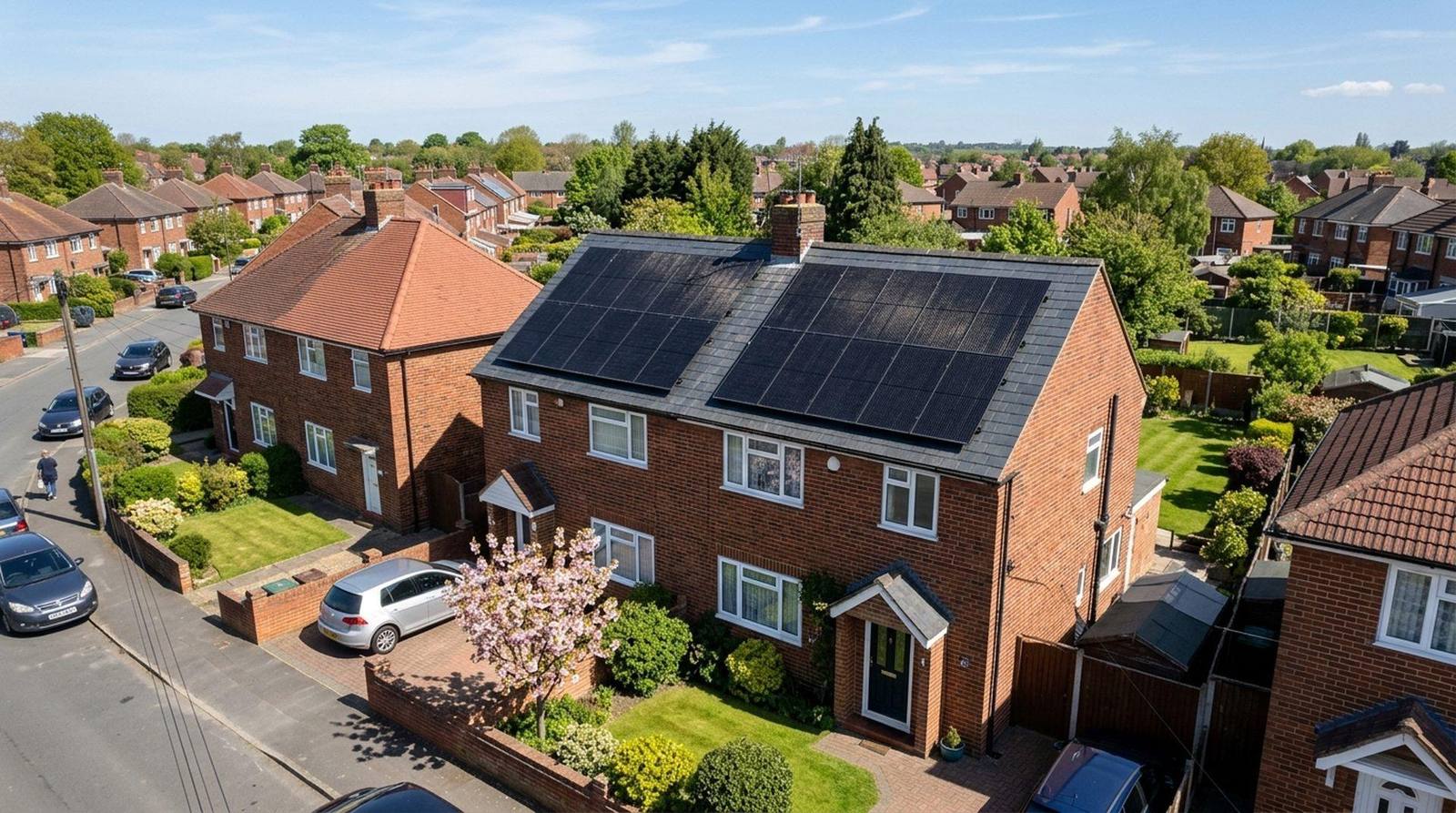
Find MCS-Certified Solar Installers in England
Compare solar installers for solar panel installation, battery storage and grant-funded residential solar. Free written quotes delivered within 48h.
Free Solar Installer Quotes
From certified solar installers Across England
Solar & Battery Services
Rooftop Solar PV
Standard, in-roof and flat-roof photovoltaic installations for domestic properties. Includes structural survey, shade modelling, panel and inverter selection, mounting, commissioning and DNO notification.
Battery Storage & Self-Consumption
LFP home battery systems retrofitted to existing solar or installed alongside a new array. Configured for time-of-use tariffs, optional backup power and up to 75% self-consumption.
Solar Thermal & Hot Water
Evacuated tube and flat plate solar thermal systems paired with twin-coil cylinders for domestic hot water — an efficient complement to PV in larger households.
Grants & Warm Homes Plan
Eligibility assessment and paperwork for interest-free Warm Homes loans, ECO flex funding and local authority top-ups available under current UK government funding schemes.
Our solar installers by region
9 regions coveredGoing Solar at Home — The Homeowner's Playbook
Residential solar has moved from niche to mainstream in England. A typical south-facing three-bedroom home fitted with a 4kW photovoltaic array now generates between 3,400 and 3,800 kilowatt-hours of electricity each year — enough to cover the bulk of daytime consumption for an average household. When the system is paired with a home battery, much of the remaining demand can be shifted out of peak tariff windows too, turning the rooftop into a genuine financial asset rather than a cosmetic upgrade.
Why solar makes sense in the UK climate
The economics have shifted decisively. Panel prices have fallen sharply over the past decade while mains electricity has moved in the opposite direction. Combined with the Smart Export Guarantee, which requires licensed suppliers to pay households for surplus generation sent back to the grid, most homeowners now recoup the cost of an installation within seven to ten years, and every kilowatt-hour produced after that payback point is effectively free for the remainder of the panels' warranted lifetime of twenty-five years or more.
Under current UK government funding schemes, the financial picture is even better. The Warm Homes Plan offers qualifying owner-occupiers interest-free loans to install solar panels alongside battery storage and insulation upgrades, spreading the outlay over manageable monthly instalments without the cost of finance eating into the savings. VAT on domestic solar and batteries remains at zero per cent, and the Smart Export Guarantee continues to underwrite an income stream from exports. Taken together, the real barrier to adoption is no longer the headline price — it is choosing the right installer and the right system design.
System sizing and battery storage
MCS certification is the non-negotiable benchmark in the UK. The Microgeneration Certification Scheme is the industry accreditation that confirms an installer has been independently assessed on competence, workmanship and customer service, and it is the gateway requirement for accessing the Smart Export Guarantee and most grant schemes. Every installer in our network holds current MCS certification, Electricians' NICEIC or equivalent registration, and is a member of a consumer code such as RECC or HIES.
System design matters as much as kit selection. The most attractive branded panel will underperform if the array is oriented incorrectly or shaded for a portion of the day by a chimney, tree or neighbouring roof. A competent survey assesses roof pitch and bearing, uses shade modelling software to predict annual yield, and specifies panels, inverter and optional battery with a clear, itemised performance estimate rather than a vague promise of savings.
MCS certification and current funding schemes
Battery storage deserves serious consideration. A 5-10kWh lithium battery captures excess daytime generation for use during evening peak hours, when grid electricity is often two or three times more expensive. Pairing solar with a battery typically lifts self-consumption from around 35 per cent to over 75 per cent, significantly accelerating payback and protecting against future tariff rises.
Planning permission is rarely required. Most domestic installations qualify under permitted development rights, though listed buildings and conservation areas need formal approval — a matter your MCS installer will check and handle on your behalf. From free survey through to grid connection, request up to three written quotes today and choose your partner with confidence.
MCS-Certified Installers
Every installer in our panel holds current MCS certification — the gateway requirement for the Smart Export Guarantee and grant funding.
Battery Storage Specialists
Solar-plus-battery designs that lift self-consumption above 75%, cutting reliance on grid electricity at peak tariff times.
Warm Homes Plan Guidance
Support with applying for interest-free loans and current UK government funding schemes that cover solar, batteries and insulation.
Transparent Yield Estimates
MCS-compliant annual performance predictions based on shade modelling, roof orientation and pitch — not marketing rounds.
Need a solar installer?
Get free quotes from MCS-accredited solar installers for rooftop PV, battery storage and residential solar systems supported by current UK government funding schemes.
- ✓MCS-certified installers only — certificates verifiable online
- ✓Up to 3 itemised written quotes to compare side by side
- ✓Guidance on the Warm Homes Plan and Smart Export Guarantee
Free survey — no obligation